
Jacob Didn't Let Go
Jacob is alone at night by a river, and he's afraid.
His brother Esau is coming the next day with four hundred men (Genesis 32:6). Twenty years earlier Jacob took Esau's blessing by deception, and he has no reason to think Esau has forgiven him. So Jacob splits his camp, sends gifts ahead, and moves his wives, his children and everything he owns across the ford of the Jabbok (32:22–23).
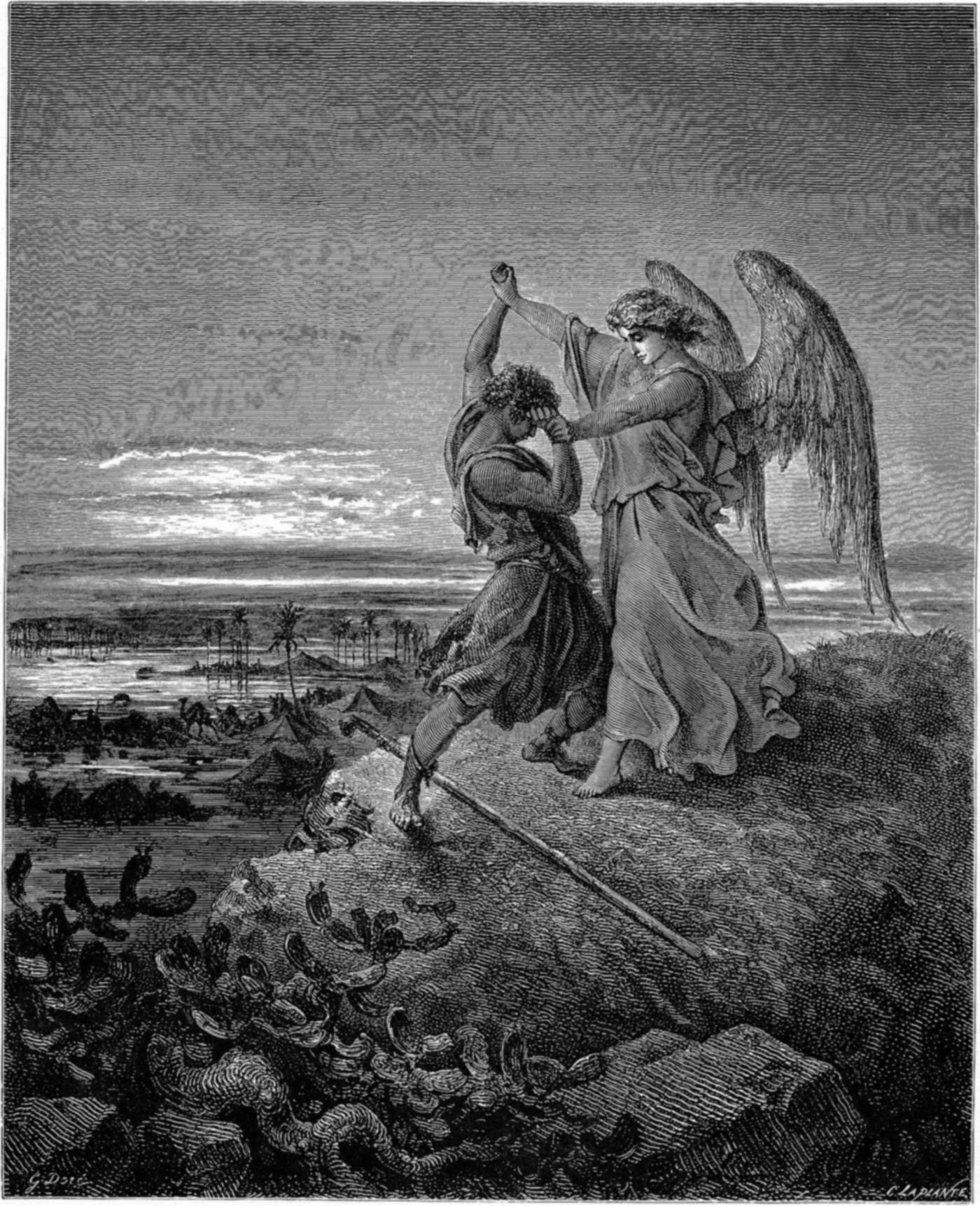
Then the text says: "And Jacob was left alone; and there wrestled a man with him until the breaking of the day" (32:24).
The text gives no reason and no warning. A man takes hold of him in the dark and doesn't let go, and neither does Jacob.
The hip goes
The fight goes on for hours. "When he saw that he prevailed not against him, he touched the hollow of his thigh; and the hollow of Jacob's thigh was out of joint, as he wrestled with him" (32:25).
With one touch, the stranger puts Jacob's hip out of joint. At that point the fight is over by any normal measure. A man with a dislocated hip doesn't keep wrestling.
Jacob does.
"And he said, Let me go, for the day breaketh. And he said, I will not let thee go, except thou bless me" (32:26).
Notice who asks to stop. It's the stranger, not the injured man. Jacob answers by tightening his grip.
The stranger asks his name. "Jacob." The name means heel-grabber, the one who takes by grabbing. "Thy name shall be called no more Jacob, but Israel: for as a prince hast thou power with God and with men, and hast prevailed" (32:28). He is blessed there. Jacob names the place Peniel, "for I have seen God face to face, and my life is preserved" (32:30).
The chapter ends with a detail most sermons skip: "And as he passed over Penuel the sun rose upon him, and he halted upon his thigh" (32:31). He walks away limping. He got the blessing and he carries the cost.
Where the blessing was
Look at the timing. Jacob wasn't blessed at the start of the night, when he was fresh, or in the middle, when both men were still strong. He was blessed after the hip went and the other man asked to stop, when every reason to let go was in place and he held on anyway.
That's the point of a top set.
Most men who've lifted for a while and look the same as they did two years ago don't have a program problem. They stop their sets while the work is still comfortable. They get to the rep where the bar slows down, where it starts to feel like a real fight, and they rack it. They count that as a set, but it isn't the set that changes anything.
The reps near failure are the ones that force the body to change. The reps before them are the walk to the river.
Voluntary hardness
In the Praos Program, one set per lift, the top set, goes close to failure. That doesn't mean sloppy, and it doesn't mean grinding with your form falling apart. It means you stop only when you have nothing left or one rep at most. You don't stop when you'd simply like to.
That moment has a name here: voluntary hardness. The bar slows, and part of you says that's enough, the day breaketh. The next rep is the one you'd rather skip. Doing it anyway is the whole practice.
Jacob wasn't trying to be heroic. He was a frightened man who'd spent his life grabbing, and this time he grabbed the right thing and held on. You don't need to feel brave to take the next rep. You just need to not let go yet.
Two cautions, because the story teaches these too.
First, Jacob limped. Hard work has a cost, and the cost is real. That's why you take one top set close to failure, not every set. You recover from it, eat for it and sleep for it. Taking everything to failure every session is how men get hurt and quit.
Second, he held on for a blessing, not for show. The top set is there to force adaptation. It isn't there for ego. Hold your form and your range of motion. A rep with half the range doesn't count.
The action today
Pick one lift in your next session. Squat, bench, row or press, it doesn't matter which.
Warm up, then do your top set. When you reach the rep where you'd normally rack it, do one more with clean form. Then write two things in your log: the weight and the rep you reached.
That number is your hold. Next week, beat it by one rep or a small amount of weight.
Don't let go before the blessing.
Scripture: Genesis 32:6, 22–32 (KJV, public domain). Plate: Gustave Doré, "Jacob Wrestles with the Angel," 1866, public domain, via Wikimedia Commons.