
I Am Doing a Great Work
Nehemiah wasn't a builder. He was the cupbearer to Artaxerxes, king of Persia (Nehemiah 1:11).
Word reached him that the wall of Jerusalem was broken down and its gates burned (1:3). He wept, fasted and prayed for days (1:4). Then he asked the king for leave to go and rebuild it, and he got it (2:5–8).
He looked at the ruin first
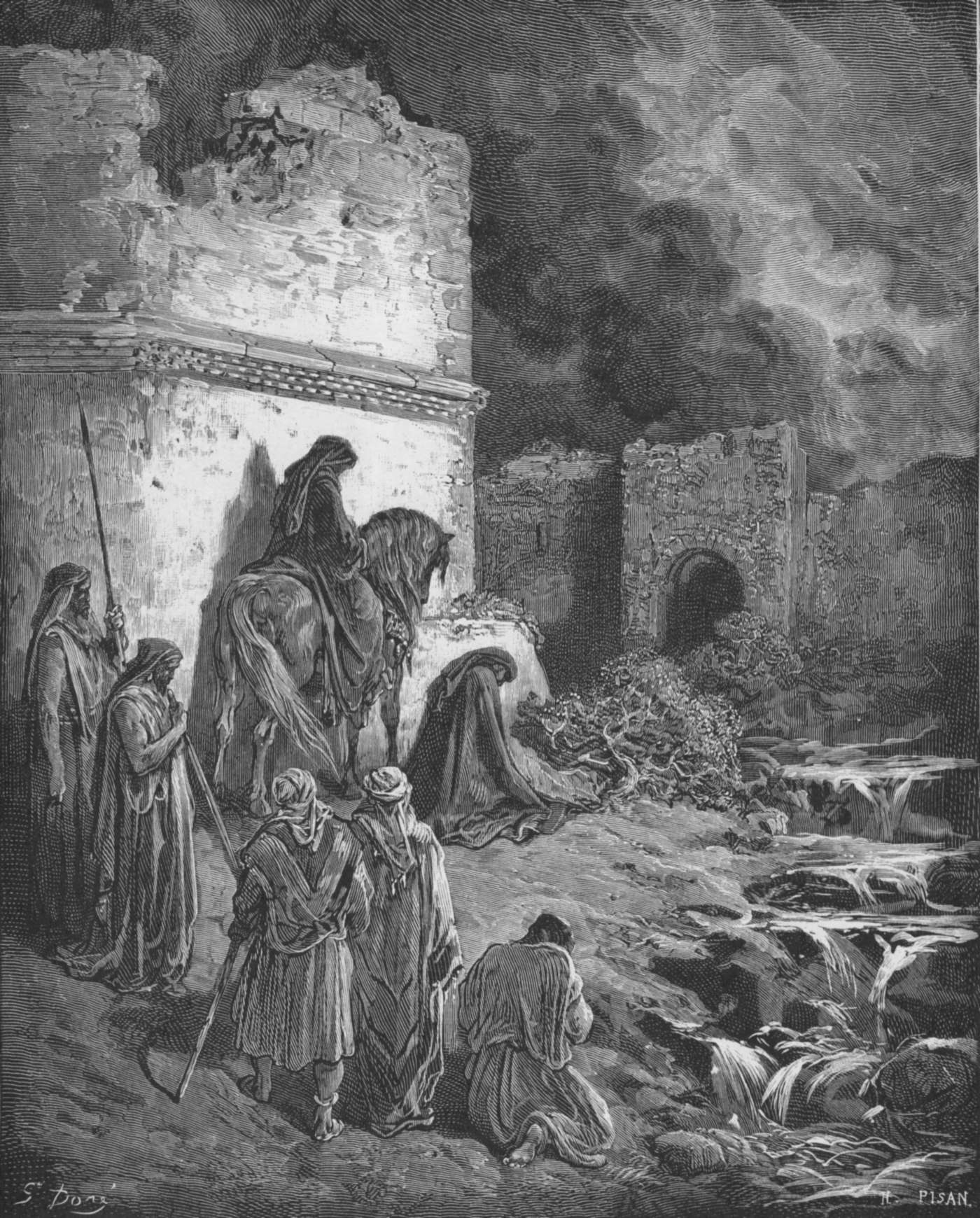
When he arrived in Jerusalem, he didn't make a speech. He waited three days. Then he went out at night with a few men and inspected the walls "which were broken down, and the gates thereof were consumed with fire" (2:12–15). At one point the rubble was so bad that his animal couldn't get through (2:14).
Doré's plate shows this inspection: a man looking at the real state of things before he starts.
Only after that did he tell the people: "Let us rise up and build" (2:18).
Section by section
Chapter 3 is a list of names that most readers skip, but it's the plan. Every family took one section. Repeatedly the text says they repaired "over against his house" (3:10, 23, 28–30). Each person took the stretch in front of him and did it.
Nobody built the whole wall. Everyone built one section, and they kept building.
The mockery
Sanballat and Tobiah laughed. "What do these feeble Jews? … will they revive the stones out of the heaps of the rubbish which are burned?" Tobiah added: "Even that which they build, if a fox go up, he shall even break down their stone wall" (4:2–3).
Nehemiah didn't argue with them. He prayed and kept building, and the next verse is the report: "So built we the wall; and all the wall was joined together unto the half thereof: for the people had a mind to work" (4:6).
The halfway stall
This part matters most for you.
Right at the halfway point, the people who had "a mind to work" said this: "The strength of the bearers of burdens is decayed, and there is much rubbish; so that we are not able to build the wall" (4:10).
That's a stall. They were tired, the rubble hadn't shrunk, and the finished half no longer felt like progress. It just felt like evidence of how much was left.
Nehemiah didn't change the plan. He posted guards, reminded them who they were working for (4:13–14), and changed one thing about how they worked: "every one with one of his hands wrought in the work, and with the other hand held a weapon" (4:17). They kept going.
The invitation to come down
Near the end, his enemies tried a different approach. They invited him to a meeting in the plain of Ono. He knew it was a trap, and he answered: "I am doing a great work, so that I cannot come down: why should the work cease, whilst I leave it, and come down to you?" (6:3).
They asked four times, and he gave the same answer four times (6:4).
"So the wall was finished in the twenty and fifth day of the month Elul, in fifty and two days" (6:15).
Your wall
Praos works on a 180-day timeline, and there's nothing clever about it. It works the way the wall got built.
Look at the ruin first. Weigh in and write down your starting numbers before you start, the way Nehemiah rode out at night before anyone lifted a stone.
Build the section in front of you. You don't build a physique in one session. You do today's top set and today's protein floor. The 180 days is a list of sections, each one done where you are.
Expect the halfway stall. Somewhere in the middle, the scale will slow and the lifts will stall, and the part you've already built will stop feeling like progress. That's chapter 4, verse 10, and it's normal. The answer isn't a new program. It's what Nehemiah did: keep the plan and change one thing, like one top set, one small adjustment to the surplus, or one more hour of sleep. Then keep building.
Answer the invitations the same way every time. They'll come: the skipped session, the "just eat whatever this weekend," the new program a friend swears by, the offer to come down to Ono. You don't need a new argument for each one. I am doing a great work, so that I cannot come down. Give the same answer four times, or forty.
Nehemiah's wall wasn't finished by a big day. It was finished because they didn't stop.
The action today
First, today's session. Show up at the time you set, log every working set, and beat one number from last week.
Then open your calendar now and put every training session for the next seven days in it as a fixed appointment with a start time. Treat it like a meeting you can't move.
When something asks you to come down from one of those slots this week, give the same answer every time.
Scripture: Nehemiah 1:3–4, 11; 2:5–18; 3:10, 23, 28–30; 4:2–17; 6:3–4, 15 (KJV, public domain). Plate: Gustave Doré, "Nehemiah Views the Ruins of Jerusalem's Walls," 1866, public domain, via Wikimedia Commons.